

At some point, the man at the front of the room will bring out a bag of craft glitter and a torch. This isn’t a child’s birthday, and he isn’t an entertainer, though there is a version of this that could play just as well at a party.
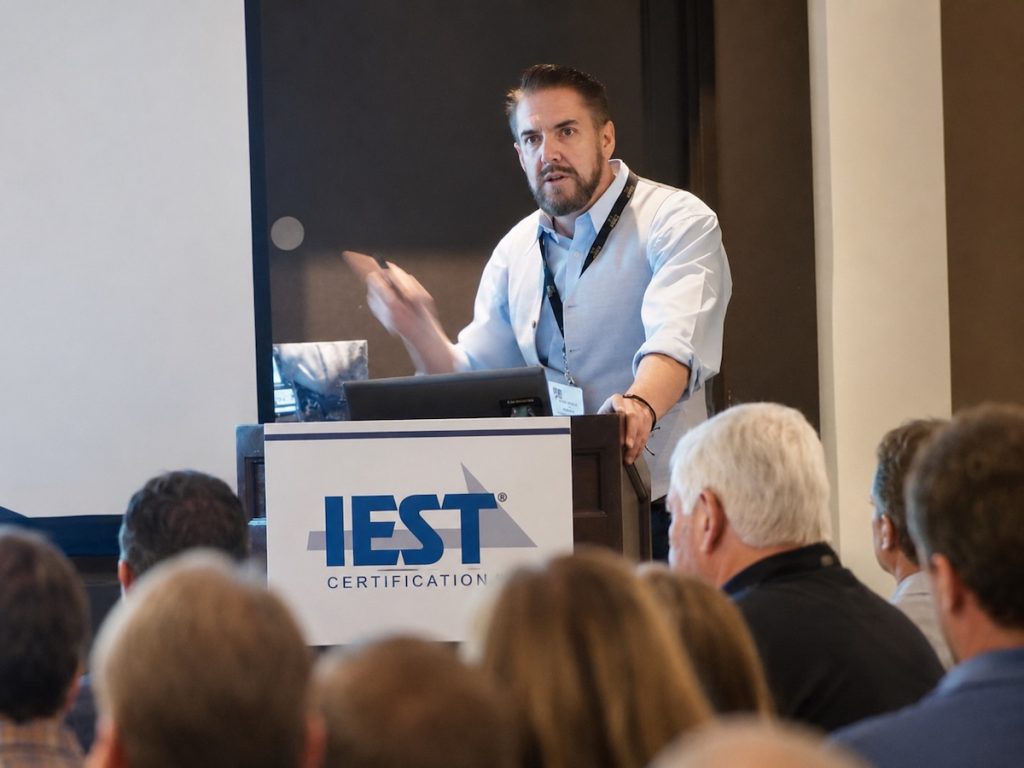
Jason Kelly is the applications director at Lighthouse Worldwide Solutions, a manufacturer of the optical particle counters and air samplers that cleanrooms rely on to find the invisible, and the glitter might just be his favourite teaching tool. He picks two volunteers and tosses a handful of the glitter into the beam – for a few seconds, every workshop participant is inside the machine. Jason is teaching them about contamination monitoring and particle counters.
He lives in Cuenca in the Ecuadorian Andes, high enough that the altitude still catches him off guard after an overseas trip. “I came back from a work trip to the US two weeks ago and, working out at the gym, I was gasping for air.” It takes a few days to acclimatise, but it is home.
The obvious question is the one his own boss asked him: why Ecuador?
His telling of this story is surreal. He was on a ride in Charleston, South Carolina, and told his Ecuadorian cab driver he’d always wanted to see Ecuador; he’d only been as far south as Costa Rica. You should go, his driver said. So he did. Three weeks later, he was in Vilcabamba, in the southern part of the country, on a nine-day retreat run by a company that sells property to foreigners and, as a service, walks them through the visas, the shipping, and the tax. Ten other people attended the same retreat. Nine of them now live in Ecuador full time.
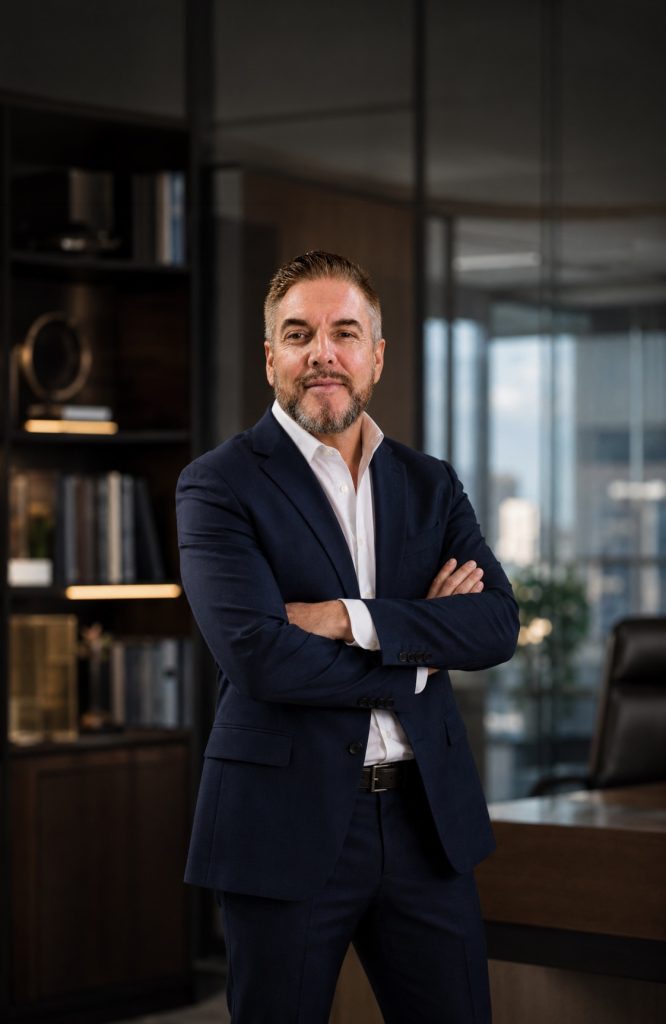
Jason remembers coming back from the event wondering if he could make this work. He confided his dream to Haşim Solmaz, Vice President of Innovation at Lighthouse, whom he calls “a most trusted colleague and friend,” on a business trip to Istanbul, and it was Haşim, he says, who helped make it happen. The two have known each other since 2013, when they met at a Lighthouse meeting in the US.
Haşim says he remembers asking him quite directly, “Why wouldn’t you do it?” And he did more than just encourage it. A Latin American expansion had already come up a few times before, and Haşim put Jason’s name into that discussion and took it to management. He says he was just a catalyst, “simply connecting two things that already made sense”, a life Jason wanted to build and an opportunity where his abilities could create real value for the company and the wider Latin American region.
His boss thought the conversation was about Jason wanting to move back to Ireland. Jason says he has no answer for why Ecuador. “I guess it’s God’s will.”
He is not, at work, a man who moves on instinct. He won’t quote on a system until he has the user requirement specification, the risk assessment, the cleanroom drawings. Not until someone has walked him through how many people will move through that room in a shift, in which direction, carrying what.
He’s been in Latin America for about eighteen months now, and spent a large chunk of this time building up service departments. “The instruments measure,” he says, “but it’s the consultancy service, and the continuity of service, behind all of that, that really makes customers see your company stand out.” So he worked with every distributor in the region to build their service departments, training engineers, installing calibration systems. The plan was to have local capability in place to provide local support to existing and new customers.
Going into the pharmaceutical facilities in the region was all too familiar in ways he did not expect. “It feels like it’s going back 30 years into Ireland.” Most companies there, as he sees them, are at the beginning. “They’re still in their infancy stage of understanding how to properly have the aseptic technique, the aseptic transfers, and the gowning basics. I see so many mistakes.” To him, there is a knowledge vacuum in the region.
The stakes are not abstract. Injectables, as Jason puts it, “go into your bloodstream, bypass your natural immune system.” In May 2025, medical fentanyl produced by an Argentine pharmaceutical laboratory was found to be carrying Klebsiella pneumoniae and Ralstonia pickettii. Ninety-six deaths were confirmed, and the government put the figure above a hundred by August, with more cases still under investigation. The families of the dead organised protests.
twenty-five minutes
Jason started his career in 1996 at Intel in Leixlip, County Kildare. Engineering courses in the city were built around the company the way the science courses were built around Wyeth. Students graduated to jobs waiting for them. He went into metal etch, working on Applied Materials P5000 machines making Pentium chips, sixteen or eighteen of them running at any one time, each one taken down and cleaned to a schedule.
He remembers it took him twenty-five minutes to gown up the first time. “Intel taught me engineering discipline, precision, repeatability, process controls, continuous improvement and became part of how I approach every technical challenge.”
In 1997, when the electronics market turned, Intel offered redundancies. Jason, recently engaged, took it because he wanted to buy a house. Soon after, he landed a job at a distributor selling particle counters into a pharmaceutical sector that was, at that point, still nascent. They hired him as a service manager. His director quickly noticed that the salespeople kept turning to him mid-meeting because he knew the answer and they did not.
Knowing the answer has always been Jason’s superpower.
He is careful to say he is not selling. “I’m not a salesperson.”
He is also honest enough, an hour later, to take it back. “I’m not a salesperson, but I kind of am without being a salesperson, because everything is based on that knowledge transfer.”
His company’s website carries a vast knowledge centre, and by his own account he built ninety per cent of it. Most of it is him giving away what he has spent thirty years accumulating. He runs a webinar every month, sometimes two.
build. repeat.
A thread runs all through Jason’s career that’s easier to see from the outside looking in. Nobody has put it to him before: that he builds the same thing, from nothing, and then leaves to build elsewhere.
Haşim says Jason is exceptionally good at taking something from its earliest start-up stage, putting the necessary structure around it and carrying it through until it becomes fully operational.
It started in Ireland. A distribution agreement with a young American manufacturer called Lighthouse in 2003, who had just released their first portable counter. Two years as their Irish distributor, installing monitoring systems into a rapidly burgeoning pharmaceutical industry. Years later, he went back and helped set up Lighthouse Ireland directly. “I became a big fish in Ireland.”
In 2007, in Melbourne, Australia, he built a service department from scratch. He tells of the laboratory he took to ISO 17025, which he calls “the pinnacle of repeatability, traceability,” and got it accredited to ISO 21501 for particle counters at the same time. By his account, no other facility in the world held both at that point. He did it again within five years at a second Australian company, and later brought the same ISO 17025 standard into Lighthouse USA.
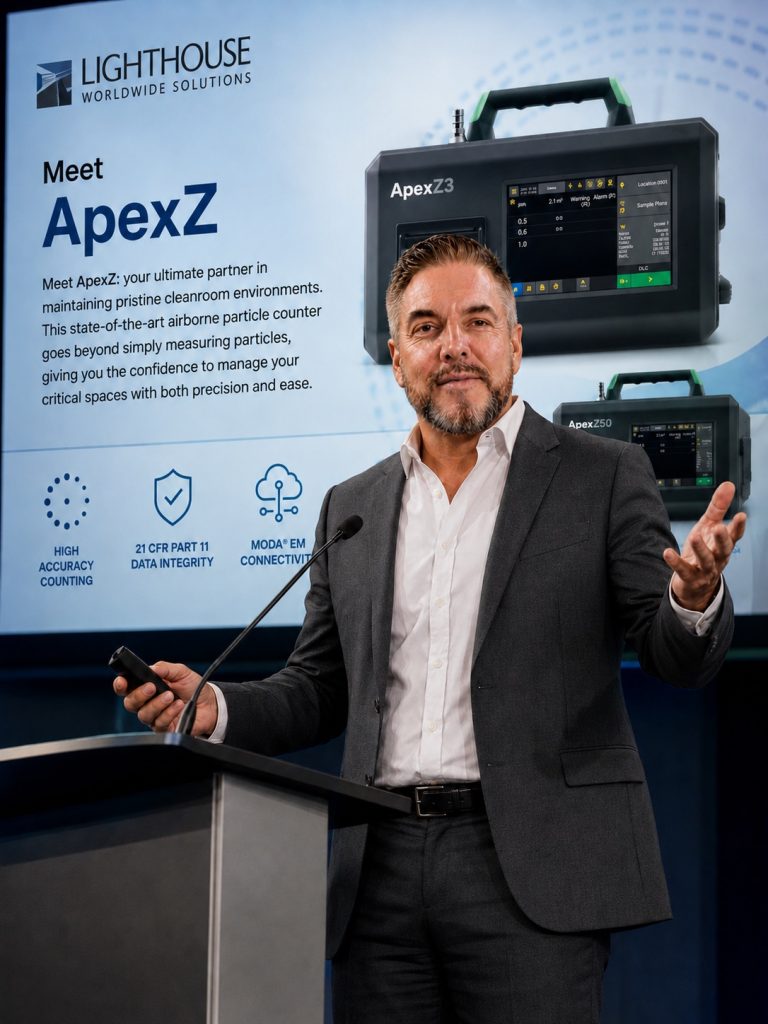
Since Jason’s first stint with Lighthouse in 2003, he has watched it grow from a start-up into an industry leader with innovation at its core. He puts much of that down to the energy of its founder and chairman, Dr Tae Yun Kim, whose mantra, “He can do, she can do, why not me!” he says, runs through the company and pushes everyone in it to be their best. “She is the most charismatic person I’ve ever met.” His own focus has settled on knowledge sharing, applications, and serving customers who need to safeguard their products through smarter environmental monitoring systems built on data integrity and data quality.
But for him, calibration is far more than just meeting compliance or a commercial application. “When we calibrate a particle counter in Argentina, and we calibrate a unit back in head office, the results should be the same. And part of ISO 17025 is inter-laboratory comparisons. So, we calibrate an instrument at head office, send it to Argentina, or send it over to India, and we want to see the same results.”
Lighthouse’s own laboratory in Türkiye has been through this. It was accredited in 2013, and Haşim says Jason came out around 2017 or 2018 to carry out an on-site assessment and lead an improvement process there. “We benefited greatly from his experience.”
He says the Australian years were good ones professionally. He was “the same big fish that I was in Ireland.” They came at personal cost. In eight or nine years there, he and his wife made it home twice. And when the offer came to move to the United States, they welcomed it, “feeling isolated from our families being so far away.” His wife was Polish, he was Irish, and America was the shorter flight back to both. They have since divorced.
When asked whether he believes there is hope for an egalitarian playing field, where children, irrespective of where they live in the world, can expect the same quality of drug, he offers two perspectives.
The first is technological and optimistic: learning curves are collapsing because information is free. The second, which he offers with more hesitation, is harder, and it isn’t confined to pharmaceuticals. “I’ve come across a few companies that just don’t want to do the right thing because it kind of costs them. And you’re going to get that in everything, human nature. You know, people are going to be driven by their ego and greed. And they’ll take that path of least resistance, and if they’re getting away with it, they’ll keep doing it.”
He does not confine this analysis to the developing world either. He reads FDA 483s and warning letters out of habit, and what he sees there are repeat offenders- established companies, even in stringently regulated markets in North America and Europe, making the same mistakes on a cycle. “It can’t be coincidental, you know?”
he gives it away
He’s made it his mission to fill that vacuum with knowledge.
He’s building a learning system to pass on all the accumulated knowledge he holds. Videos, modules, test questions, a certificate at the end, running from what a cleanroom is up to sterile pharmaceutical applications. It first went out to the Latin American distributors.
He is also watching this knowledge disseminate independently of him. “I’ve seen people that are new in the industry, and they have this AI-generated information. And I’m going, wow, that’s competing with my knowledge now, over 30 years. They can get to that stage very quickly.” But is this knowledge backed up by experience?
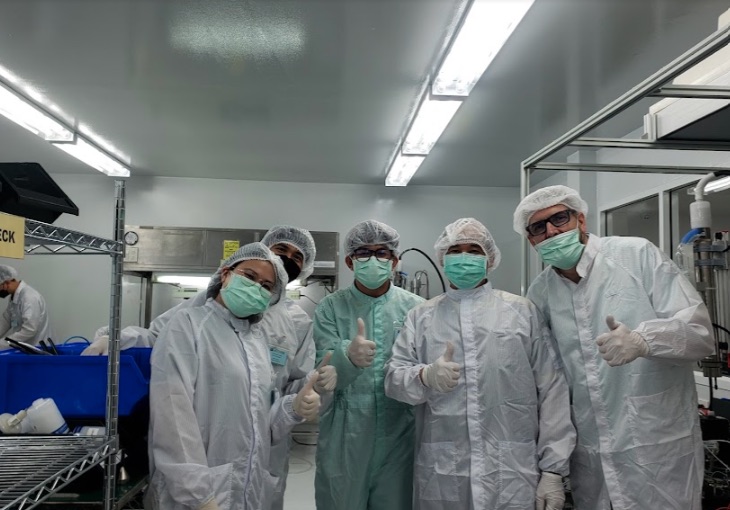
It doesn’t bother him. It’s how the gap closes, and closing the gap is the reason he is in Ecuador. He repeats something that stopped him short when he heard it, a statement he attributes to Pfizer: that within five years they want no people in their cleanrooms at all. He expects the industry to go that way. He does not sound entirely comfortable about it.
“It fascinates me and scares me at the same time.”
He has a way of describing his own industry that would make marketing leads everywhere gasp in horror. “At the end of the day, all particle counter and air sampler manufacturers make good products. It’s like we pick a car – Hyundai, Toyota – what’s the difference today? It’s what’s behind that.” And then: “The instrument is just incidental.”
Which circles back to the question of equal standards for all. A laboratory accredited to ISO 17025 has to prove that an instrument sent to Buenos Aires reads what it read in California. It’s the point of inter-laboratory comparison, and Jason built his career around it before he had any reason to care about Latin America. He’s been consistently enforcing the equality he could not promise, one calibration certificate at a time.
mind, body, soul
Up in the mountains above Cuenca, Jason is roughly halfway through building a large fish pond on his property, its wastewater feeding a polytunnel, waterfalls running down the slope, and a natural swimming pool you can swim in alongside the fish. He built a biological filter into it, sitting in a basket, cascading down into the pond below. He describes it the way he describes a monitoring system, in terms of what the by-product does next. Aquaponics, he says, is an intelligent use of what the fish leave behind. Haşim says it is in many ways “a very typical Jason project,” and the life he’s building in nature is true to the person.
He is also, without any hesitation, a deeply spiritual man. He believes in consciousness, in the connection between mind and body and soul, in natural healing, in frequency and vibration. He keeps three or four close friends and sorts them by energy. “I connect with these people that I feel they vibrate with my energy as well.” He is not troubled by holding these beliefs alongside three decades spent making pharmaceutical manufacturing safer, and he does not appear to have been asked to reconcile them before.
At this stage of his career, Jason could be working in Fremont or Oregon or Ireland, in English, but here he is starting again in a language he doesn’t have. He has given himself six months to deliver a presentation in Spanish, then a workshop in Brazil, where it will have to be Portuguese. His fiancée is Ecuadorian and fluent in English, which doesn’t really help, he says. “I’m very much of the mindset that you have to challenge yourself all the time.”
Quite like the cold water immersion he practices. “You’re more angry because you’re physically immersed in something that you shouldn’t be in. That challenges your existence.” What he takes from it is what he takes from metrology. “Once you control the mind, you control everything.”
