
The contractors still come to gawk at the mud house going up next door, an oddity among their cement-and-saria builds, half confused, half curious. Eventually they seek out the architect, card in hand, asking if there’s work for them. When she says there’s no RCC, reinforced cement concrete, on her site, only mud and bamboo, natural materials native to Goa, their confusion is complete. She mischievously asks them why they don’t use natural materials instead. Better still, give her some work. “Just as a joke,” she says, “we turn the tables.”
It’s only partly a joke. For thirty years, Tallulah D’Silva has systematically discarded everything that makes construction in India expensive. Her lighthearted subversion helps her make the case for natural materials to anyone who will listen: clients, architects, babus, contractors.
cement must go
The first thing she discarded was cement.
When she began practising, natural building came to her “like a default setting.” An architect by training, Tallulah began under her mentor, Ramesh Bandekar, who in turn learned from Laurie Baker, the British-born architect who spent half a century in India building cheaply with local materials. She never met Baker, but took his teachings as tenets for how she wanted to practise. She brought everything she was taught into her own projects. Over time, she came to feel that even thoughtful builds took something from the land that could not be put back. It got to the point where she started to see how even a simple family dwelling can wreak destruction on the environment.
She tells of an advertisement for cement: a famous Indian movie star telling people which cement to use, villagers lamenting their mud homes, wanting pucca cement houses. People watch ads like these, she says, and decide that is the standard they must aspire to. A concrete house, she says, needs iron ore and sand mined and stone quarried, damage that is irreversible. Whatever architects build, she came to see, the environment pays for, her work included. “So we are being hypocritical in a way.” She started asking why building costs so much and found the answers were a lot simpler than she expected. She points to birds and insects that build with what is available and do not compete over whose dwelling is best.
Her case against concrete extends to sleep. She describes families who build with expensive materials, granite and concrete, only for their oldest members to complain they cannot sleep. The floor is too hard; the walls trap and throw the heat back, and nobody rests without an air conditioner.
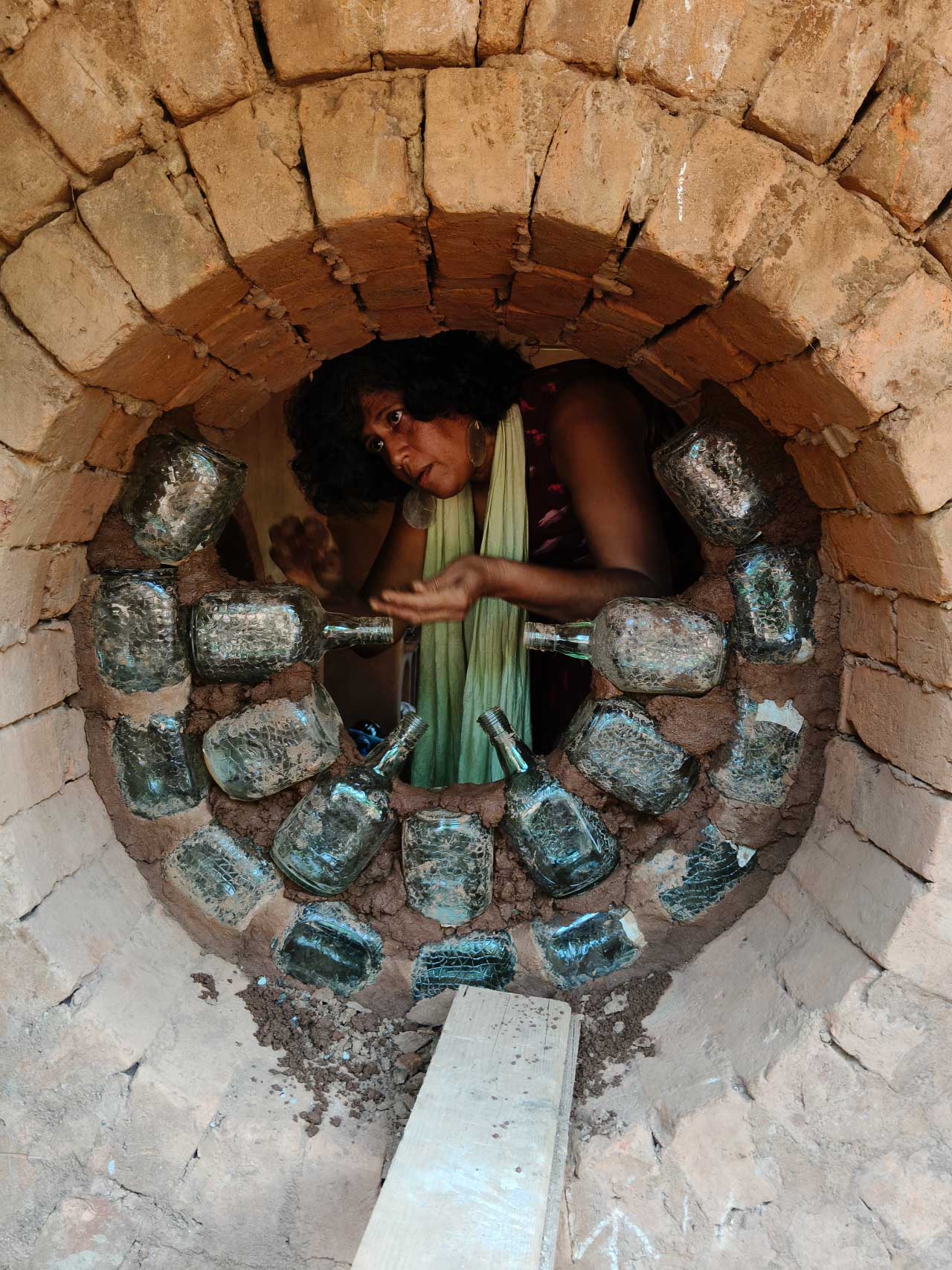
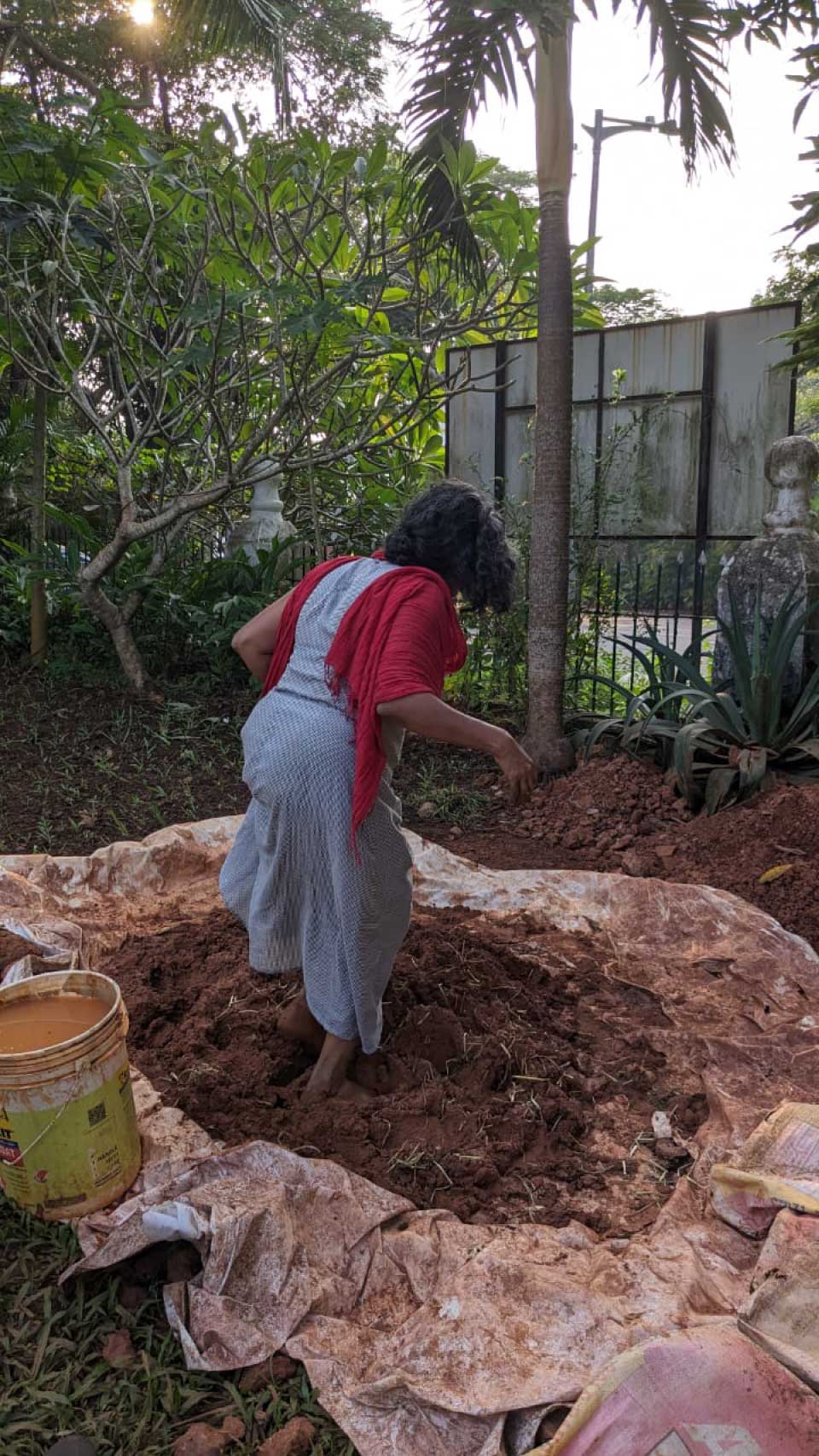
She turned that lens on her own work first, and it was the axis on which her whole career turned. She chose Earth. Her materials of choice became mud, laterite, lime, salvaged clay tile, reclaimed timber, bamboo, glass bottles set in windows and walls, red oxide floors, and the debris and excavated earth other builders dump. Villagers who come to see her houses are stunned that they’re made of mud. She asks why they think something this simple is not mainstream.
then the middlemen
Tallulah keeps a direct line to the owner, and to every mason, even when the team runs to ten people. “If you look at when people work with hierarchies, and there are too many middlemen or middlewomen, information is lost. Trust, she says, is built one-on-one. Without it, costs go up, people misunderstand each other, and owners give up and switch to reinforced concrete. Instead of a contract, she uses an MOU, a memorandum of understanding, and a cover note explaining why the house is being built this way, a process she learned from Baker. She designs for a percentage and makes 10 per cent on the build, intentionally low because she wants the owner to take an active role in the process rather than pay to be left out. When an owner wants to run the build themselves, she trains the masons, holds their hands through it all, and charges nothing for her time. When people tell her they cannot afford an architect, she asks only if they want to build with mud. “Then I’ll give you my full support. No charge.”
Anyone may walk onto her sites, watch the work, talk to the owners. She builds in public, publishing her methods so anyone can follow them. Half her work is unpaid. “Fifty per cent of my work is volunteering.”
finally the architect
Tallulah holds her own profession accountable for the poorly designed boxes most of India lives in. Only five per cent of people building a home in India will hire an architect, she says, while everyone else uses contractors to copy what they see. Any way you look at it, architects decide what a village looks like, including the houses they never drafted. What they have taught villages to want, she says, is “a box. And we are forced into that box.” It wears on people’s mental well-being. She doesn’t think it is a matter of taste. “It’s a crime, actually.”
The architect in her plan is meant to become unnecessary. The house, she says, shouldn’t carry her mark, but the owner’s chapa, their stamp.
Ahana Rao, an architect who set up the Tambdi Maati Foundation with her, says she has always built with mud, from her very first project and pushed clients to build less. “She firmly believes that mud building should not become exclusive, and that’s what it’s becoming now, that you see only that the rich can afford to build with mud.”
babus come last
The village is one front. The government office is another. Officers at the Town and Country Planning department have told her they know her, and her work, so she needn’t come in for permissions. She should send the client instead. Much can be gathered from what is unsaid. She tells them point blank that she won’t pay bribes and is willing to wait them out. “You want to delay our file; we will put a letter that you are delaying the file.” She goes to panchayat meetings, the village councils that pass building plans, with owners to make their case, and asks why officials are harassing people she says are doing the village a service by building with earth and waste. Each step helps get things done without lining anyone’s pockets. She learned from her mentors that if a file was held up too long, she could go straight to the concerned department to complain. She would tell them she would start building the next day, under the deemed-permission provisions in force at the time. She has held this stance since the beginning. Her first clients were farmers with budgets of about one to two hundred thousand rupees, and she says she built their homes within that sum. She also went to the authorities on their behalf so they wouldn’t have to pay bribes to get the plans passed. “I’m very proud that I did that, because I realised by not compromising I was able to build.” This ethos sometimes costs her the project; not all owners want to wait it out with her.
we’re all artisans
Asked who her biggest ally is, she immediately names the artisans who work with her. Her first lesson came from the mason on her first project, who had never made a jali wall, a wall of patterned openings, or set glass bottles into masonry, and tried both anyway. “We worked in a way, like, as if we were friends.”
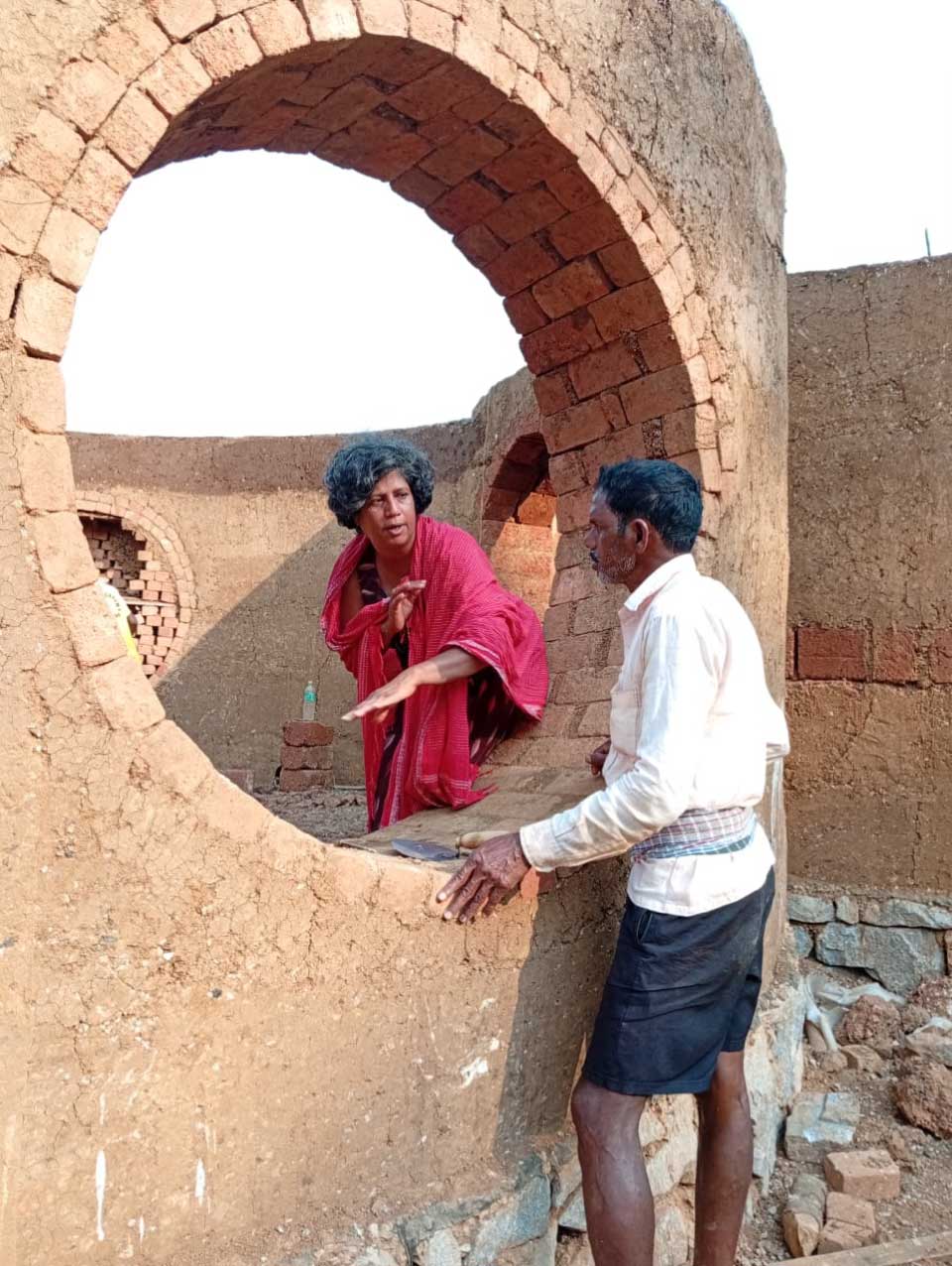
Her artisans come from West Bengal, Jharkhand, Bihar and Uttar Pradesh, and she says they remember working on mud houses in their own villages, in lives sensitive to nature. More women are joining her team, a stark contrast to the all-male crews that man construction sites across India. She says women bring discipline and a spirit of collaboration; on her sites, everyone sings and laughs. She’s ferocious about ensuring the artisans have good working conditions and time to rest. When an owner complains they are not getting the full eight hours, she claps back. “We are building a human dwelling.” A building, she says, “which has joy in its making.” She wants the artisans to get the credit. “They are,” she says, “the face of every great piece of design and architecture.”
Rahuman Kalil, a student who interned with her for about four months, remembers celebrating the workers’ birthdays with cake, treats, and wishes; keeping track of their health and troubles; and supporting their children’s education.
Ahana has worked beside her for two years. “Usually people would think of masons as labour”, but they are equals on Tallulah’s sites. “There is no hierarchy that she maintains.”
roots
Goa, Tallulah says, is everyone’s favourite commodity. Builders sell villas with swimming pools to buyers who think they’ve made a worthy investment. She asks whether a water-short state can afford villas full of chlorinated water when it already has natural water bodies. Elsewhere, the rich are being sold eco villages. A young product designer who interned with her put it plainly: “Our villages are already eco. Let the privileged come and live in the villages and bring their money with them.”
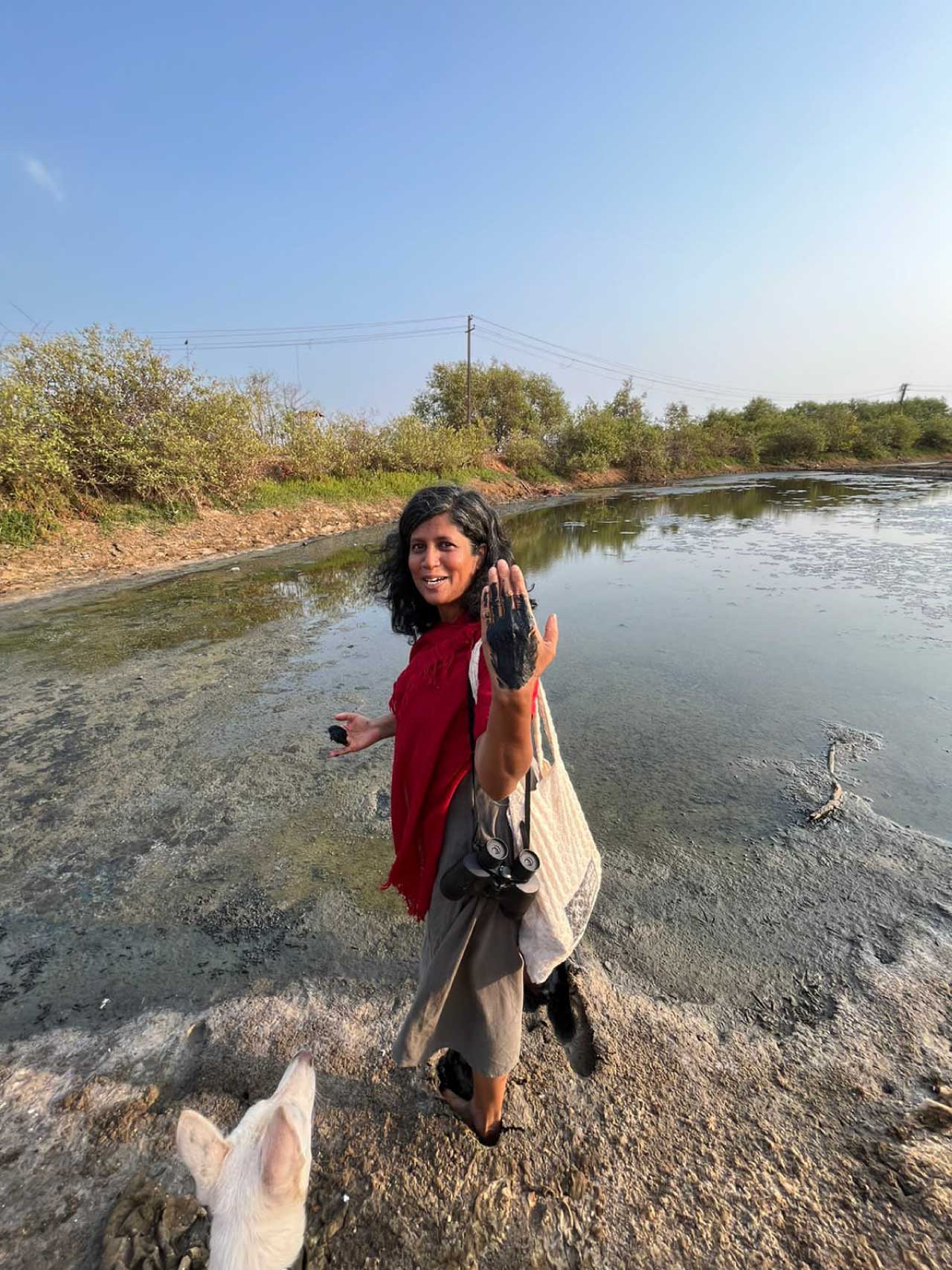
She takes groups into those villages, parents from the United States and across India among them who want their children swimming in backyard ponds and saline ponds, instead of chlorine. Children, she says, will scream and shout, and throw pebbles into the water. “Adults will say don’t do that. But that’s spontaneity.”
She was one of these children. She grew up at the foot of Altinho, climbing its gentle slopes with her friends to forage for berries in the summer. When the rains came, they went into the khazans, the tidal fields, and the mangroves of Taleigao and Santa Cruz. Her walk home from school along the Ourem Creek was full of unexpected diversions; she’d come home with frogs in her raincoat pocket and a scolding for being late. Holidays were spent in Canacona, the southernmost tip of Goa, where her father’s parents lived. There were so few people; the whole place felt like hers. She sat on the riverbank, under the mangroves, watching the fiddler crabs while her father swam. At her mother’s family home, there was an unfenced pond in the backyard, and the children were left on their own with one warning: somebody could drown. They knew what boundaries not to cross. But she and her friends knew some places were off limits. When asked what she wanted to be when she grew up, she says she never thought about it until school forced the question. “I was just so happy being.”
She says that time is still what she works from. “Growing up, spending so much time in nature built that memory, that lasting memory for me, and a reference for me.” When she meets someone new, she introduces herself through nature first and her profession second.
She gets her soft-spoken gentleness and her love for the great outdoors from her father, a banker who carried squirrels in his pocket and swam rivers with his two dogs swimming beside him. He knew everybody: the boatman, the man at the chai shop, the people he sang bhajans with at the temple, and she says her love for community comes from him. He was, she says, always the first to apologise after a quarrel. She calls it “his softness as a man, his gentleness as a man.” The thread of tensile steel that runs through her spine comes from her mother, a fierce warrior who stood up to corrupt colleagues in the fisheries department where she worked. Her mother came from a humble family and faced discrimination. When her daughter did the same with politicians and officials, she worried, only for Tallulah to turn it back on her: “You’ve taught me the same values, and now why have you been protective towards me, that way?”
Tallulah’s sons are 21 and 15, and were both raised outdoors, in forests and on long trips. When they started asking whether they had to come, she brought along other children from the neighbourhood and slowly the group grew. She now runs nature walks and programmes for families. Neither son, she says, is interested in becoming an architect, and she doesn’t want them to. She’s let them go, the way a hornbill lets a fledgeling go, “You give them strong wings. They can choose.” She asks only that some part of what they do goes back to the community.
fill the earth
She would rather multiply than lead. In August 2025, she, Ahana and Omkar Keni founded the Tambdi Maati Foundation to train young architects across the country to lead mud projects, a springboard into practices of their own. Within a few months, she says, they were working with four of them. She tells young architects that big salaries come with compromises and that a big office “leaves you very empty.” Some have left those very offices to work on her sites. One walked away from a teaching offer at one of India’s top architecture schools to train with her.
Snishtha Bhatia, a designer who met Tallulah at a talk in Mumbai, moved to Goa and spent her first day going round three of Tallulah’s sites in Batim. “Meeting her and her work felt so grounded at the time.” Asked what the work gives people, she says it goes past skill. “I think it brings about hope and belief more than anything else.” She also noticed the pace. “Although she talks really softly and has a really calm energy, she’s an eager beaver in her day-to-day.” She describes her as “the kindest person that you’re going to meet.”
Rahuman remembers her cooking for him at her home, asking him if he liked seafood or chicken and how spicy he wanted it. One day, he says, she handed out needles and coloured yarn and taught the interns to crochet.
For Tallulah, the ambition is people, and she collaborates with anyone willing to play with mud. She lets schoolchildren as young as second grade onto her live sites, and they work with mud and cow dung. She wants schools to teach building alongside composting and farming. “Building should be compulsory.” She runs programmes for architecture students in remote Goan villages, where they camp for several days, to measure old houses and build with mud. Friends in Maharashtra, Sachin and Minal, who run Syamantak, the University of Life, in Dhamapur, Maharashtra, offered her land last year for a training centre beside a tribal community whose young people, she says, leave for Mumbai and live in terrible conditions there. She wants to run a free residential programme that teaches them carpentry and mud building. She is writing a curriculum, slowly, for the gaps she sees in how architects learn to plan and build. “Maybe we can have a school, or an architecture school, with a small number, where we can practise these values.” Masoom Education, a Mumbai organisation that works with night-schoolers and dropouts, has asked her to build a training centre using mud. There will be no middlemen. “Our dream is to revolutionise mud building, to make it so popular, to teach people that it is affordable, that you don’t need an expert. You are the expert.”
let go
Asked which of her roles sits closest to her, architect, activist, or teacher, she pauses, seemingly considering it for the first time. It is being empathetic. When a client is in difficulty, she cannot help responding. “Sometimes it comes at a huge cost, and I feel I’m crossing my boundaries.”
There is another cost, which she brushes off. Lost work. Designers with prestige projects, owners who wanted the best house in Goa, and wanted it fast. Mud takes its time. When an owner decides to switch to RCC for speed, she leaves. “So then I have to let go, and I’m more than happy to let go.” She doesn’t count it as a loss. “We don’t have to give up anything, but we are only receiving more and more, I feel.” What crossing her boundaries cost her, she did not say.
When she is unsure, she turns to God. She wrote that her belief in a higher power keeps her accountable, honest and truthful. When a problem comes up, she surrenders it, and that surrender lets her think her way to another answer.
The hardest resistance to reconcile comes from her own profession: architects who have made their peace with bureaucracy. “We may be thrown out of our architecture community clubs, the IIA and others, but we have to be assertive.” She points out that many of the architects speaking up for a different kind of architecture are women.
She was fearless when she started, she says, and bold. She still follows her heart, because the mind always asks if it will work. “And the heart always trusts.”