


Every morning, for about five years now, Elijah De Souza has ridden a scooter to a restaurant near his ancestral home in Anjuna to pick up the wet waste they generated the day before. The scooter has been modified to carry two blue 50-litre barrels on a stand he built himself. When he gets there, he swaps his empty barrels for full ones, nearly 100 kilos of waste every day. When he can’t go himself, he asks someone else to stand in. “If I’m not there, I need to get somebody else to do it,” he says, “but you don’t skip a day, rain or sunshine.”
Later that day, he sorts the waste with his one employee, a woman who comes in every afternoon. They check again for bottle caps and plastic that got past the restaurant’s own check. Vegetable scraps will feed the 20 or so stray cows, who now turn up “religiously”, and some go to his pigs and hens. Everything else goes into his compost pits. He spends roughly five thousand rupees a month on the sorter’s time and petrol to process waste from one restaurant alone. Roughly 36 tonnes a year. The restaurant pays nothing.
The cows are relevant for two reasons. The first is land. Composting 100 kilos of waste a day would take an acre or two, and in Goa, where land prices are “crazy high,” the land itself is an endangered species. A cow, he says, eats eight to ten kilograms and leaves less than half a kilo of dung, which is far easier to compost. “So you put in 10 kg one side, and then you get 500 grams the other.” The second is what they would eat otherwise. An acquaintance who treats sick cattle has told him horror stories about the plastic stray cows carry in their stomachs, accumulated over the years. Some, the man told him, carry 50 kilograms. “That’s literally a bag of cement,” Elijah says.
Inchara, who rented a room from Elijah’s family, found him through the far end of the chain. She wanted compost for the organic farm she was volunteering at, and most everything on sale was “smelly, bad quality goo.” His vermicompost was different, “so good and alive, I could eat it,” she says with a laugh. She put it under a microscope to be sure.
it’s all rubbish
Fifteen years ago, the tiny seaside village of Anjuna was a little parcel of paradise with a pristine beach. Now it is one of the most popular tourist destinations in North Goa, crowded and messy, noisy year-round. Tourists leave when their holiday ends. Locals like Elijah live with what they leave behind.
Goa had nearly 11 million tourist arrivals last year. The state waste corporation’s own 2018-19 survey puts its waste at 766 tonnes a day, roughly half of it wet. Wilma Rodrigues of Saahas Zero Waste says this will go to 1000 tonnes a day by 2030. Anjuna produces about 1.7 tonnes a day, per a January 2025 Navhind Times report, so Elijah’s barrels hold about a seventeenth of it. The same report quotes the panchayat on a mismatch in pickup timings: contractors collect in the morning. It blames restaurants, shacks, and clubs for illegal dumping, saying they work evenings and are closed when contractors come. The panchayat’s solution was 20 CCTV cameras and stiff fines. Of Goa’s 191 village panchayats, only six meet the rules for their waste sorting sheds. Anjuna is not one of them.
Elijah has a proposal for the panchayat: house stray cattle wandering about in a gaushala and feed them restaurant waste collected within a day. He has a blueprint but doesn’t have the bandwidth to navigate red tape. “Too much bureaucracy. The land that is required, the delay, all a permit issue.” Panchayats, he says, talk about wet-waste budgets in crores. “What are they doing with all those crores? You can’t really see anything.” Later asked if the system makes him angry, he says it does and that the anger is useful, “keeps me going each day, because I feel that they are not doing a proper job that they are assigned to do, and I can do it better than them with a much smaller budget as compared to them.”
In Oxel, another North Goa village with its own panchayat, a video report shows ‘No Garbage Dumping Zone’ boards standing, in all seriousness, over garbage heaps that dot the roadside like a dystopian Hansel and Gretel trail. Garbage that eventually makes its way into the fields. Residents ask how there is money for CCTVs but none for bins.
the other way around
Jonah Fernandes, Elijah’s friend and occasional workshop collaborator, who runs Zeroposro, a zero-waste store in Panaji, told Linchpin that managing waste after it’s made means you’ve already lost. “The real question is: how do we not generate it in the first place?”
Elijah starts at the other end, with what a restaurant has already thrown out. His method depends on speed. “Because we collect it in less than 24 hours, it’s very fresh; it’s not fermenting and getting spoiled.” In 2023, he wrote a chapter on his waste work for a TEDx anthology on climate action. Back then he put it at 70 kilos a day.
Inchara calls him an environmental and land rights activist. He refuses the label. Asked whether he’s focused on keeping his corner of the world clean, whatever else was happening, he says he does what he can. “I know it’s a small fraction of the thing, but the self-satisfaction that you get, knowing that you’re taking out that many kgs per day from the restaurant.”
books, bottles and hands to spare
Elijah has a habit of finding a use for whatever is about to be thrown away. He runs a lending library, The Booktique, from his parents’ house in Goa. He started it in December 2018 with Emmanuel Souza, his best friend since first grade, after years of talking about it. They listed 300 books in a PDF and charged 20 rupees a week. Books were delivered by bicycle. Some ordered just to see if anyone would turn up. “People thought we were crazy.” On weekends he would come home from college to a table covered with orders his mother had wrapped in newspaper. Emmanuel has since gone overseas to study, and Elijah has run the library alone.
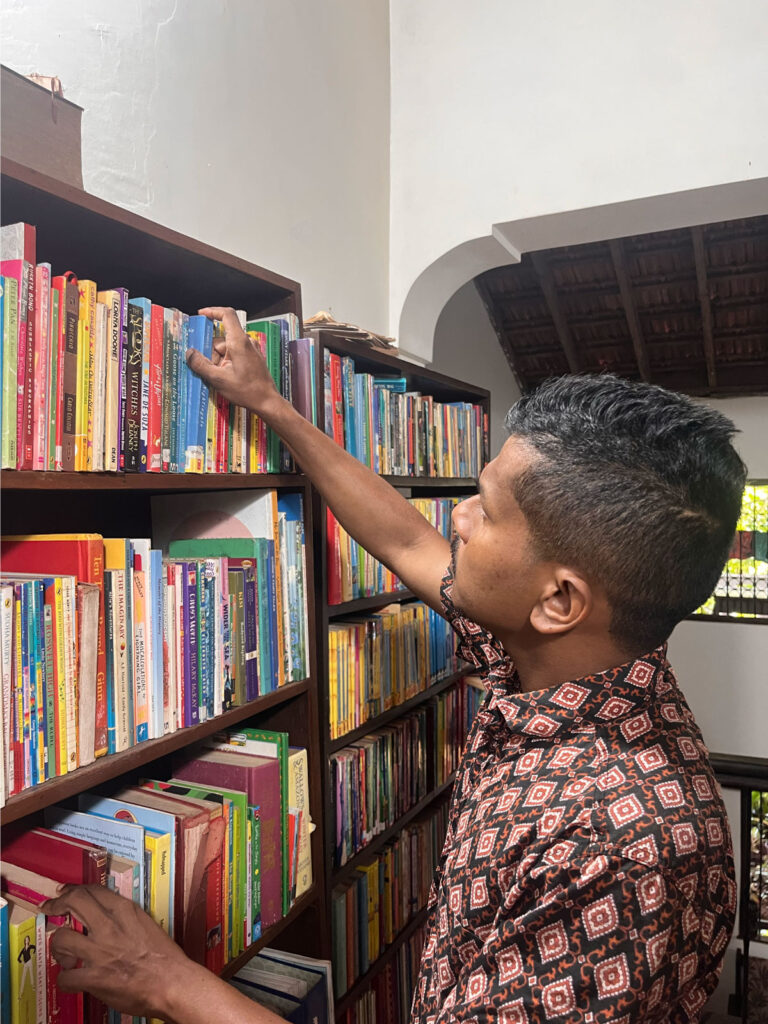
More than 4000 books now sit on the shelves he built from the pine offcuts of packing crates. “Some of them are a bit wonky,” he says, “but we did it all on our own.” Many of the books came to him because somebody no longer wanted them, others because they needed a forever home.
Like the man from Pilerne with his late brother’s books: textbooks, old Portuguese editions, titles that may be out of print. By Elijah’s account, he first asked the state library and then Goa University to collect them, but neither came. Elijah recalls him saying his dog chewed on one book every night, “so there’s one book lost forever.” Elijah went over the next day and took them all. “All these big libraries, who have so much money,” he says, “and they can’t do simple things, like send a tempo.”
Textbooks are given away for free via WhatsApp groups. Duplicates are sold to keep the library going. Boxes of books go to libraries in rural India, and librarians from Goa collect them from him in Porvorim. The website runs on a subscription model, and he delivers the books himself, cycling everywhere within a 20 km radius. Someone gave a boy called Ethan a year’s membership without checking if he was in range. “It was very difficult for me to say no, so I literally did 27 kilometres one way.” With a fast reader, it’s two trips a weekend. For Ethan alone, that came to “almost 108 kilometres each week.” Sounds impossible, but Elijah is an endurance cyclist who once rode 600 kilometres in 39 hours and 45 minutes.
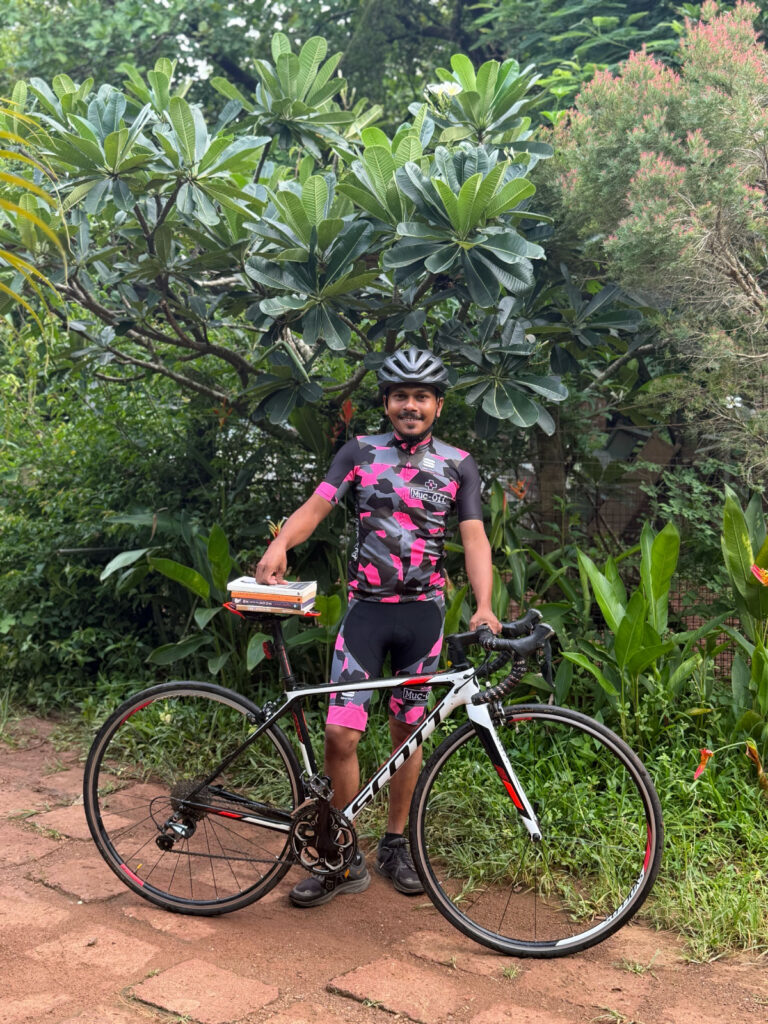
When he noticed the same fifty or so books were borrowed while thousands of others were ignored, he saved up twenty-seven thousand rupees to upgrade the website so readers could browse by subject. He wishes the big libraries would do the same so their books aren’t “just lying on shelves, collecting dust.”
Francila, a borrower from the start, says that on National Book Lovers Day this August, a Sunday, he cycled round to every customer. Months before her wedding, he gave her a birthday present she hadn’t asked for: a book that had come to him. A book of gowns by a well-known Bombay seamstress, put together by her children. Francila is into fashion design. “He will not see somebody just as a customer or a client,” she says, “but he will remember the person.”
give me one night
In every community everywhere in the world, there is that one person everyone knows. You may not know exactly what he does, but you know he’ll come if you need him. Elijah De Souza is that person in Anjuna.
Nearly eight years running The Booktique have also given him an enviable list of contacts across North Goa, and he lends them out occasionally in support. Like the homemade coconut vinegar maker. He asked her to make a poster and posted it to his groups. She sold thirty or more, and he carried bottles as far as Panjim himself and gave her every rupee. When she asked him why, he said he wanted to learn the market for homemade vinegar. When we pressed him on it, “I remember when we started in 2018 and all of that. I wish somebody would have supported us in that way.”
Then there’s John, the rice farmer who organised sixty dhonnes, a traditional Goan sweet, for a rice-transplanting workshop. The workshop didn’t have any takers, even at just 400 rupees a head. For his final-year project at college, Elijah studied rice farming in Goa and found that farmers either make a small loss or break even. “Give me one night,” Elijah told John. His post brought more than twenty people to the workshop the next morning.
A woman behind on her rent once messaged to ask if he could sell her old books for her. He took three or four sack loads and expected them to sell slowly. Within the first week, 95 per cent were gone. “This was one customer that I didn’t want to fail,” he says, “because they were really in a bad state.”
Every few months his family holds an event for the vaddo. A neighbour’s daughter bakes, a friend runs a juice stand, a tenant once taught acrylic painting, and he pays them all. Children of labourers who work the fields come for free; he pays their instructor from book sales.
the hills were alive
In the stories he tells friends, Elijah spent much of his childhood alone in the hills above Anjuna, among the trees. He tells other kinds of stories too. Inchara says people miss how funny he is, and that if you get him on to ghost stories, “he will not shut up.” As a small boy, he wanted to join the army. Or fight fires. Then in ninth standard, Miguel Braganza, who would later become his mentor, gave a career talk in school and mentioned that Goa would soon have its first agriculture college. “And that was it.” His friends sat for engineering and medicine entrance exams; he went cycling. His father was upset and angry. On admission day, they drove to remote Sulcorna. “But now, I know that he loves what I’m doing.”
He describes himself quite cheerfully as “almost failing and sometimes failing” at college, with subject backlogs his parents never knew about. “But you put me in the field, and all my field marks would be A plus, plus, plus, plus.”
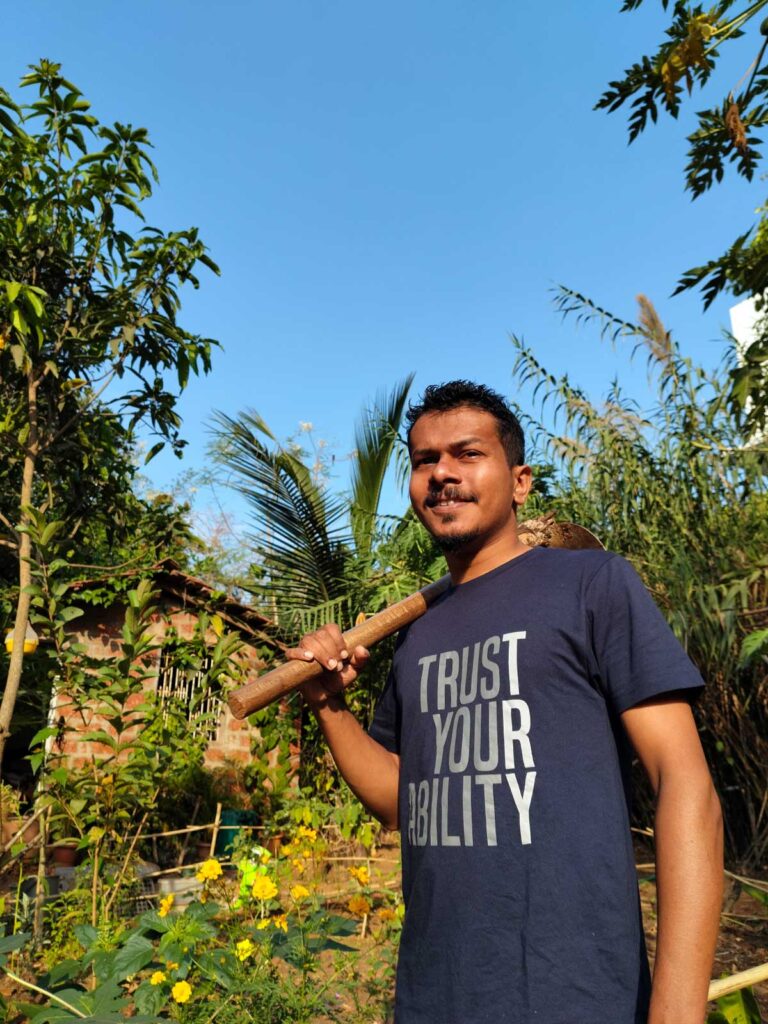
Asked why he does any of it, he goes back to the hills that came alive for him. “I think it’s love for the land, you know, that you grew up on.” That love permeates much of his daily life. When he was small, there was no rubbish outside his house. Now there’s some at the door every morning, and left alone, he says, the road in front of his house would be a dump in two or three weeks. He says it’s easy to glaze over something you get used to. “After some time you just become blind to it. I don’t want to be blind to the garbage just outside the door, right?”
Sometimes the love goes public. In 2020, during the pandemic, young Goans ran an online campaign against three government projects that would cut through the Western Ghats at Mollem. Elijah painted outlines of dead trees on every book parcel that left the library to raise awareness.
sans invoice
People closest to him have noticed how much he gives away. His friend Inchara has spent years asking him to charge for his ecological work, going so far as to threaten to become his fake manager and send the invoices herself. He always says he’ll start, she says, but never does. Inchara has since come around: “Some things cannot have a price point, especially when it comes to saving Goa from ecological degradation.”
His paid work follows its own rules. As a landscaper, he refuses villa gardens. “You put plants in the borders, and they call it a garden.” He asks every client if they would like a tree and says the question “lights up a bulb in the eye.” For one cafe he planted for butterflies; the owners told him later they get lost in the garden before the workday begins.
He also teaches children to grow food at two schools in Porvorim and runs workshops for grown-ups. I sat in on two: one on vermicomposting and one on kitchen gardens. The first myth he took apart was that compost has to smell. If you bed it with coconut husks, he said, you could even keep the bin under your bed. He left one at Zeroposro, Jonah’s store, where the workshop was being held, and they fed it vegetable scraps every week; there really was no smell. He showed us how to work with local materials, most of them free, with no expensive tools. His earnestness drew us all in. Everyone, including me, took notes and asked questions. I live in a flat – I don’t even have a garden.
The landscaping and the teaching jobs pay. He keeps a share when he resells other people’s books. When one of the schools offered him a full-time role at good pay, he refused. He did not want to leave the other school on a month’s notice, nor did he want to give up everything else for “perhaps a thousand, 2000 more in my bank account.”
His biggest fear, he says, is burnout, yet the one resource he won’t budget is himself. “Right now, I’ve reached maximum capacity.” Asked where he finds the energy, he talks of it as something young that will not last. “I know it doesn’t last too long, but as long as it lasts, I’m going to pick myself up every single morning.” When he feels low, he goes to his sister, who lives a block away. When money runs short, “you just whisper a prayer. And somehow or the other, it just works.”
This year he began farming his family’s fields again. He thinks they were last cultivated in the ’80s. He’s clearing the weeds by hand, without weedkiller, and so far there is a small patch of turmeric and some rice.
He is twenty-eight, an agriculture graduate, and tomorrow at dawn he’ll ride his modified scooter to pick up waste at the restaurant again.
